
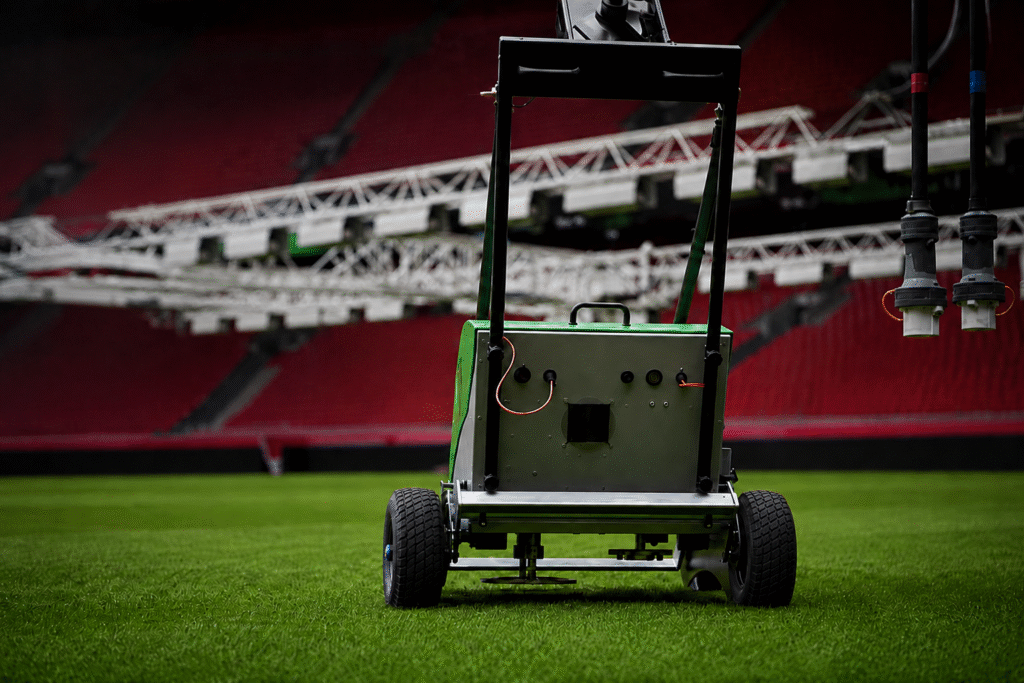
The HiPSter has passed the FIFA Test Event 2026 of the FIFA Quality Programme for Natural Playing Surfaces. The result proves that the HiPSter measures according to the same FIFA criteria as FIFA-accredited test laboratories, producing equivalent results. This makes the HiPSter the first and only automated measurement system to pass this test.
Why frequent testing matters
Traditionally, the quality of a pitch is tested a few times a year by a test institute. In between, turf professionals rely on their experience. Whilst the experience and expertise of the field manager will always remain crucial, data supports them by allowing them to back their decisions with objective insights.
A pitch is never the same from one week to the next. Every match, training session and maintenance task leaves its mark, and conditions differ from one spot on the pitch to another. On top of that, a changing climate brings heavier rainfall, longer dry spells and more extreme temperatures, which change pitch conditions faster and less predictably.
A test a few times a year shows where a pitch stands at that moment, not where it is heading. Frequent testing shows trends, reveals deviations early and makes the effect of maintenance visible. That is what allows turf professionals to act on data: to manage on quality and to maintain preventively instead of reactively.
One-time testing provides a benchmark. Frequent monitoring enables you to manage towards it.
Built for self-testing
Frequent testing only works if it is reliable and accessible. A complete pitch test traditionally requires several separate instruments, trained operators, a lot of time, and the outcome partly depends on who takes the measurement.
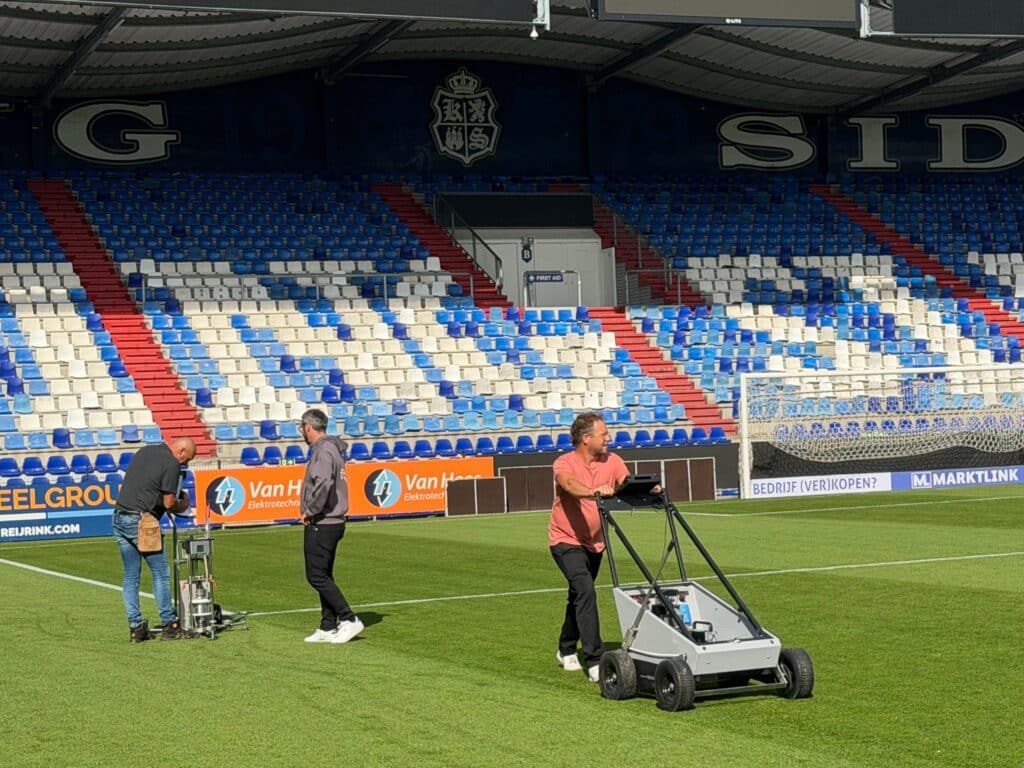
That is why we designed the HiPSter. By integrating separate measurement instruments into one automated system, operated at the push of a button, the HiPSter makes complete pitch tests possible for turf professionals to carry out themselves, as often as they want.
A full pitch is measured in under 30 minutes.
Why the FIFA Test Event matters
And that is exactly why passing the FIFA Test Event matters. Self-testing is only valuable if you can trust the outcome. Because the HiPSter measures automatically, the result no longer depends on who takes the measurement. The FIFA result now confirms that these measurements are equivalent to those of accredited test laboratories.
As the first and only automated system to pass this test, the HiPSter shows that frequent self-testing and reliable testing go hand in hand.
One system, above and below the surface
The HiPSter brings sports-technical measurements and agronomic data together in one system.
The performance measurements follow the test methods prescribed in the FIFA Quality Programme test manual for natural playing surfaces. They describe how a pitch plays and how it treats players:
- Shock absorption and vertical deformation: how the surface absorbs a player’s impact and how much it gives way. A surface that is too hard increases the load on players; one that is too soft feels unstable and tiring.
- Energy return: how much energy the surface returns to the player, which affects how a pitch feels to run on.
- Rotational resistance: the grip players have when turning and accelerating. Too little grip causes slipping; too much puts extra strain on knees and ankles.
- Surface hardness: the overall firmness of the pitch, which affects both player safety and ball behaviour.
- Ball rebound: how the ball bounces off the surface.
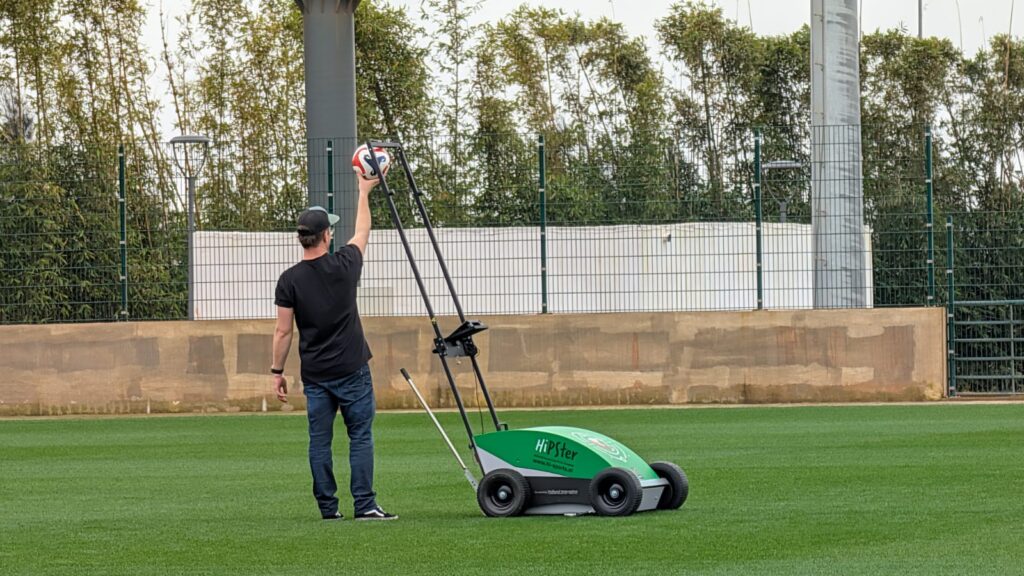
Together, these measurements give an objective, comparable picture of playing quality and safety. With the FIFA result, turf professionals can now take these measurements themselves with the same confidence as an official test, and follow them week by week instead of a few times a year.
The new Soil Module adds the agronomic side, measuring penetration resistance, soil moisture, soil temperature and EC at the same spot, in 15 seconds. That is where the extra value lies. The performance data shows how a pitch plays; the soil data shows why. Is the surface getting harder because the rootzone is drying out, or because the soil is compacted? Soil moisture tells you whether to irrigate or to aerate. Low grip can point to a wet surface or to weak rooting. Soil temperature shows when grass can grow and recover, and EC indicates nutrient availability. By measuring both at the same moment and location, you can see cause and effect, and choose the right intervention.
From measuring to knowing
Every measurement is automatically synchronized to the Hi Dashboard. There, performance and soil data come together with weather data, maintenance activities and the match and training schedule. Trendlines and heatmaps show how a pitch develops, spot by spot, and how it responds to use and maintenance. That reveals the patterns behind pitch quality: which areas wear first, how quickly the pitch recovers after a match, and which interventions actually make a difference.
On top of this, we develop predictive models. The first is our predictive irrigation model, which combines measured soil moisture with weather forecasts, climate data and agronomic data to predict how the soil moisture levels will develop up to two weeks ahead. Because it learns day by day how each pitch behaves, its advice is tailored to that specific pitch. That helps turf professionals plan their maintenance towards matchday, so the pitch plays exactly as intended when it matters most. The model is already in daily use, and more predictive models are on the way.
Professionals keep making the decisions. Data helps them make those decisions with confidence, and show what their work delivers.
Proven in elite football
Developed in the Johan Cruijff ArenA, the HiPSter is now used by clubs and federations in the Netherlands and abroad. The Danish Football Association, for example, uses it across its second and third tiers and at its national training centres, and took it along to the EURO 2024 in Germany and the Women’s EURO 2025 in Switzerland. At the UEFA European Under-19 Championship in Romania, the HiPSter helped fine-tune pitch quality in the run-up to the final.
Turf professionals know their pitches better than anyone. What they deserve is data they can rely on, as often as they need it. This result is a big step forward in automated self-testing. And we are only just getting started: with the soil sensor and predictive models, we will help turf professionals make the right decision at the right moment.
Tijs Meeske, Business Manager Hi Sports
Want to know what the HiPSter can do for your pitch?
About Hi Sports
Hi Sports brings data-driven pitch management to clubs, stadiums, municipalities, federations and contractors. With the HiPSter, the Hi Dashboard and AI models, organisations measure the performance and soil quality of their own pitches and turn that data into targeted maintenance: better pitches, more playing hours, less water and fewer materials. The HiPSter is a modular, automated measurement system, developed in the Johan Cruijff ArenA and used by, among others, the Danish Football Association. The technology is developed in Brainport Eindhoven.